Recovery Advice
Legal Vehicle Recovery: Untaxed and Abandoned Vehicles
Not every vehicle move is a breakdown. Untaxed and uninsured vehicle removals, abandoned cars, private land obstructions and what makes a recovery operator legitimate.
There is a category of vehicle movement that has nothing to do with breakdowns: cars that need to be removed for legal reasons, or that cannot legally be driven anywhere.
This is worth understanding both if you are the one who needs a vehicle moved and if you are the owner of one that somebody else wants moved.
Vehicles that cannot legally be driven
A vehicle that is untaxed, uninsured, without a valid MOT, or subject to a SORN declaration cannot be driven on a public road, even a short distance, even to a garage.
The one exception is a pre booked MOT appointment, which permits driving an untaxed vehicle to and from the test, and even that requires insurance.
That means moving any of the following is a transport job rather than a driving job:
- A car declared SORN that needs to move between addresses
- A vehicle bought at auction with no tax and no insurance
- An untaxed car sitting on a street that needs to go
- A vehicle whose MOT expired while it was off the road
- An inherited or repossessed car with no current documentation
Driving it instead risks a fine, penalty points, seizure of the vehicle and, if there is no insurance, a much more serious set of consequences.
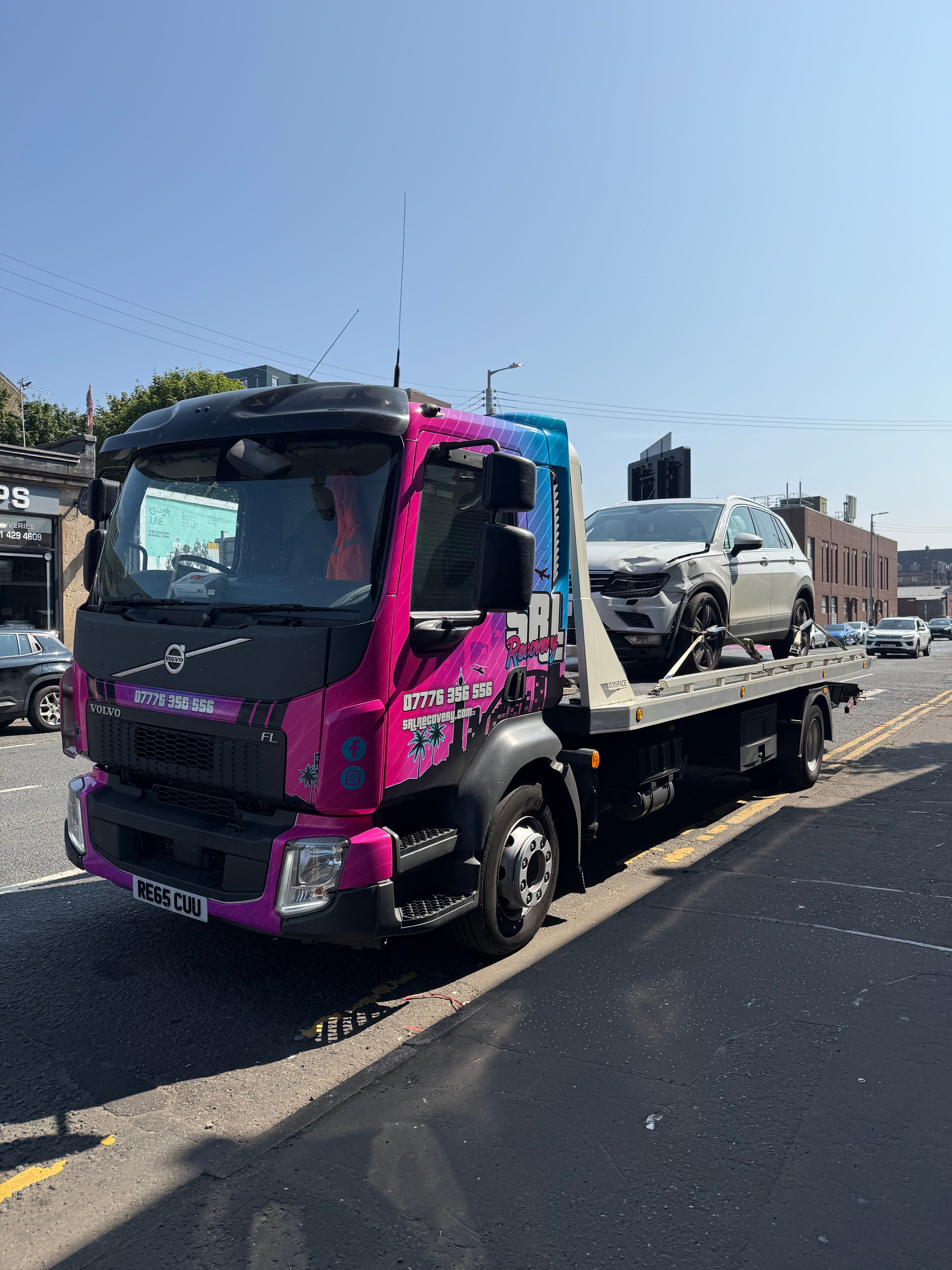
Recovering it on a flatbed sidesteps all of that, because the vehicle is a load rather than a vehicle in use. See our vehicle transport service.
Untaxed vehicles and DVLA enforcement
The DVLA runs continuous enforcement against untaxed vehicles, using its own records rather than physical checks, and vehicles on public roads can be clamped or removed.
If your vehicle has been clamped or taken, the release process involves paying the outstanding tax and a release fee, plus daily storage while it sits in the pound. Those charges accumulate quickly, so speed matters more than being annoyed about it.
If you are trying to avoid all that with a vehicle you cannot tax right now, the answer is to get it off the public road onto private land and declare it SORN, and to move it on a truck rather than driving it.
Abandoned vehicles
An abandoned vehicle on a public road is a matter for the local authority. They will investigate, attempt to trace the registered keeper, serve notice, and eventually remove and dispose of it. The timescale is measured in weeks rather than days, which is frustrating if you are the neighbour looking at it.
On private land the position is different and often worse, because the landowner is responsible rather than the council.
If a vehicle has been dumped on your land, you cannot simply have it taken away and crushed. The registered keeper retains ownership, and disposing of somebody else's property exposes you to a claim. The process involves attempting to identify the keeper, serving proper notice, allowing a reasonable period for collection, and only then arranging disposal through a licensed operator.
Where the vehicle is genuinely at end of life, disposal through an authorised treatment facility gives you a certificate of destruction, which is the document that ends your liability. That is a job for a licensed ATF rather than a recovery operator, and any ATF will arrange its own collection.
Vehicles blocking private land
A car blocking your driveway, your access or your car park is a civil matter, not a police one, unless it is causing an obstruction of the public highway or a genuine emergency access problem.
The practical route is usually to establish whether you have the legal right to remove it, which depends on signage, on whether it is a private car park with terms displayed, and on the specifics of your situation. Getting that wrong can turn your problem into an expensive one.
Where removal is lawful, it needs a properly insured operator using appropriate equipment, and a documented process: photographs before the move, a record of where the vehicle went, and a chain of custody. A vehicle that vanishes without a record is a dispute waiting to happen.
What makes a recovery operator legitimate
Worth knowing whichever side of this you are on.
Insurance covering vehicles in their custody, which is separate from ordinary motor insurance and has a stated limit.
Correct licensing for what they do, including an authorised treatment facility licence and a waste carrier registration if they are handling end of life vehicles.
Documentation. A written record of the vehicle, its condition, where it was collected from and where it went. Photographs at both ends.
A traceable business. Company name on the truck and the paperwork, a fixed address, and a proper receipt.
Be cautious of anyone offering to take a vehicle away for cash with no paperwork. If it is scrapped without a certificate of destruction, you remain the registered keeper in the DVLA's records and remain liable for it.
What we do
SRL Recovery handles statutory and legal removals, untaxed and SORN vehicle movements, non runner collections and abandoned vehicle recovery across Glasgow and Central Scotland, with the insurance, licensing and documentation to go with it. We are a recovery operator, not a scrap dealer or an ATF, so we do not buy vehicles for scrap.
Vehicles that will not roll are handled with wheel skates rather than dragged, which matters for cars that have been standing for years.
Call 01698 700970.
Quick answers
Can I drive my untaxed car to the garage? Only to a pre booked MOT appointment, and it still needs insurance. Otherwise it has to be transported.
Someone has dumped a car on my land. Can I have it removed? Not immediately. The keeper still owns it, so there is a notice process to follow first. Get advice before disposing of it.
How do I make sure a scrapped car is no longer my responsibility? Use an authorised treatment facility and obtain a certificate of destruction, then notify the DVLA.
Can you move a SORN vehicle between addresses? Yes, on a flatbed, which is the only legal way to move it.