Services
Sports and Supercar Transport in Scotland: Track Days, Dealers and Auctions
Moving a Ferrari, Porsche, McLaren or a restored classic without a breakdown involved. Covered transport, track day logistics, auction collection and dealer delivery across the UK.
Not every job involving a valuable car starts with something going wrong. A large share of the high value work we do is planned transport: a car going to a track day, a purchase being collected from a dealer four hundred miles away, an auction lot needing moved, a restoration going back to its owner.
Planned movement has different requirements from roadside recovery, and it is worth understanding what to specify.
Why not just drive it
People ask, and there are good reasons.
Mileage on a low mileage car is money. Several hundred miles added to a collectable to save a transport fee is usually a poor trade.
Stone chips, road salt and weather do real damage to paint that cost five figures to apply. A winter motorway run puts grit into every seam.
Then there is the practical issue that a lot of these cars are not registered, not insured for the road, not taxed, on trade plates, or not in a state to be driven at all. A restoration that has just been painted has no interior. An auction purchase has no keys. A track car has no MOT.
And a car with a fresh engine build should not be doing a long motorway run as its first outing.
Open deck or covered
The main decision, and it comes down to value and weather.
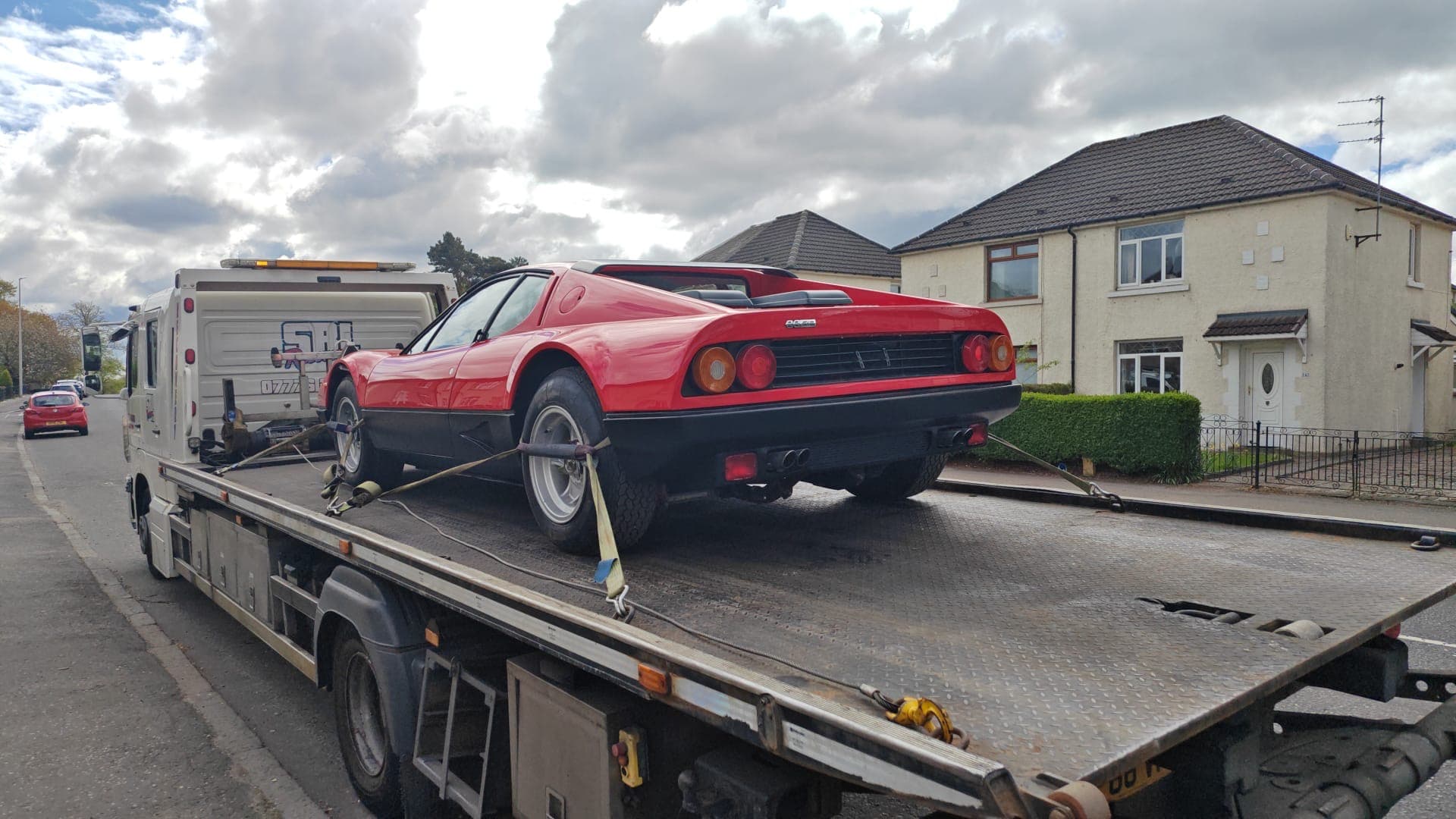
Open flatbed is fine for most performance cars in reasonable conditions over reasonable distances. It is quicker to load, cheaper, and gets into places an enclosed transporter cannot.
Covered transport earns its cost for concours cars, freshly restored vehicles, anything going to or from auction where condition is the sale, and any long distance move in Scottish winter. It also matters for cars with soft tops, exposed carbon, or paint finishes that mark.
If you are unsure, the question is what a full winter motorway run of grit and salt would cost to put right afterwards.
Loading a car that sits on the floor
Ground clearance is the single biggest practical constraint with sports cars.
A modern supercar, or anything lowered, has an approach angle measured in a very few degrees. Standard steel ramps will catch a front splitter, and on a carbon splitter that is a several thousand pound noise.
The equipment that solves it: aluminium extension ramps to lengthen the transition and flatten the angle, and where necessary a low approach loader instead of a tilt bed. On the very lowest cars, low profile boards go under the leading edge as it comes up.
Many modern performance cars also have a nose lift function on the front suspension. Tell us if yours does, because it changes what is possible, and tell us if it is not working.
Strapping a car you cannot touch
Wheel straps over the tyres, to rated anchor points, pulling the car down onto its own suspension. Nothing hooks to a subframe, a wishbone or an arch liner.
Nothing crosses paint. Anywhere a strap could contact bodywork, padding goes in first. Carbon panels, splitters and diffusers get particular attention because they crack rather than dent.
For a car with a very stiff setup, the strapping tension is set to hold the car without loading the suspension through a long journey.
Track days and events
Event logistics are their own thing.
Getting a car to Knockhill, to a Scottish sprint, or down to a circuit in England means arriving at a specific time, dealing with paddock access, and often collecting again at the end of the day when the car may or may not still be driveable. Track day damage is common enough that a return leg for a non runner is worth planning for.
Wheels, tyres, tools and spares travelling alongside is normal. So is collecting a car that has been off in a gravel trap and needs skating onto the deck.
Tell us the event, the times and whether the return is confirmed or conditional.
Auctions, dealers and private purchases
The other regular strand: you have bought a car somewhere else in the country and it needs to get here.
The practical points. Auction lots frequently have no keys, flat batteries and seized brakes, which makes them non runners regardless of condition, so skates need to be on board. Collection windows are tight and storage charges start quickly. Dealers need notice and a named collection contact. Private sellers are often unavailable at the times a transporter is passing.
Say what you know when you book: whether it runs, whether it has keys, whether it rolls, where exactly it is standing and what access is like. Those five answers decide whether the job takes forty minutes or four hours.
We run collections across the UK, including regular routes south via the M74 and Carlisle.
Storage and onward movement
Where a car needs to sit somewhere between legs, or while a repair is arranged, we can hold it securely rather than leaving you to sort it at short notice.
Related services
For breakdown situations rather than planned movement, see prestige car recovery and classic car recovery. For general movement, vehicle transport.
Call 01698 700970 with the car, the two addresses and the dates.
Quick answers
Do you offer enclosed transport? Yes, for concours, freshly restored and auction cars, and for long distance winter moves where open deck is not appropriate.
My car is extremely low. Will it load? Yes, with aluminium extension ramps or a low approach loader. Tell us the ride height and whether it has a nose lift.
Can you collect a car with no keys from an auction? Yes. Auction lots are usually non runners and we bring skates as standard.
Do you cover track days? Yes, including delivery, paddock collection and recovery of a car that does not drive home.